
Tuesday, March 27, 2012
The culture week!

Saturday, October 29, 2011
olives
Summer has finished. We now have time to enjoy the autumn food...Let's pick the olives to make fresh oil for bruschettas! In the countryside you can see people climbing olive trees or using ladders to reach the highest olives on the tree, letting them fall down on the nets. Here in Tuscany we pick the olives with the hands and soon they get pressed in the olive mill. The oil is ready!

The Tuscan olive oil is not only very good (one of the best) but also very healthy. This is the right season to tour around in the countryside and visit oil mills and farms to taste the fresh pressed extra vergine olive oil.
Contact us for suggestions or tours.

The Tuscan olive oil is not only very good (one of the best) but also very healthy. This is the right season to tour around in the countryside and visit oil mills and farms to taste the fresh pressed extra vergine olive oil.
Contact us for suggestions or tours.
Saturday, May 28, 2011
Florentine mosaics
Only skilled and experienced craftmen are able to transform the rough stone in a "painting". The inlay work is a very difficult technique that need precision, creativity, deep knowledge of the different stones and their nuance, structure, and, above all, passion.
 This is the result of three years' work by Jacopo Lastrucci, from the Lastrucci workshop in Florence: the Sibilla Libica, from the fresco by Michelangelo in the Sistine Chapel. This wonderful panel can be seen in the workshop. It is a nice experience to visit the workshop and see the Lastruccis working and creating new mosaics.
The inlay work, or "commesso in pietre dure", as we call it in Italian, was started in 1588, when Ferdinando I De' Medici founded the Opificio delle Pietre Dure for the decoration of the interior of the Princes' Chapel in San Lorenzo.
The stones were marbles, granites, porphyre, jaspis, lapis lazuli, calcedonium, malachite, quartz.....
The museum of the Opificio delle Pietre Dure displays the stones used, the working tools used to cut them, to glue the pieces, and the evolution of this technique from the end of the 16th century to the modern times.
Also, in occasion of the 150th anniversary of Italy, an interesting exhibition is now going on in the Gallery of Modern Art until next September: when Tuscany became part of the Italian Kingdom the granducal manifacture (Opificio delle Pietre Dure) started to have a larger public...

The inlay work, or "commesso in pietre dure", as we call it in Italian, was started in 1588, when Ferdinando I De' Medici founded the Opificio delle Pietre Dure for the decoration of the interior of the Princes' Chapel in San Lorenzo.
The stones were marbles, granites, porphyre, jaspis, lapis lazuli, calcedonium, malachite, quartz.....
The museum of the Opificio delle Pietre Dure displays the stones used, the working tools used to cut them, to glue the pieces, and the evolution of this technique from the end of the 16th century to the modern times.
Also, in occasion of the 150th anniversary of Italy, an interesting exhibition is now going on in the Gallery of Modern Art until next September: when Tuscany became part of the Italian Kingdom the granducal manifacture (Opificio delle Pietre Dure) started to have a larger public...
Wednesday, May 4, 2011
Craftsmen festival in Florence
 Artigianato a palazzo is a three day exhibition of almost 100 craftsmen who recreate their workshops in the beautiful garden of palazzo Corsini. This festival, held this year from May 13 to 15, is a chance to appreciate florentine artisans while they work, understanding the ability and the hard work they put into their creations. The fair showcases craftsmen that work with glass and silver, to those who restore wood and marble furniture,to confetti makers and much more.
Not to lose is also the historic garden whose lemons are centuries old just like the palace, and the possibility of relaxing , have a drink offered and some tuscan food prepared for the visitors...

Sunday, April 24, 2011
A cow for the Duomo
When Brunelleschi's Cupola was built, timber frameworks surrounded the cathedral. The north side of the Duomo faces via de' Servi, and in one of these apartmente a young and nice taylor lived and worked, who sometimes came to the window to get more light, or simply to look at the men working at the cupola, when her husband wasat w ork. A love story started, and one of these stone carvers sculpted a head of a cow, with a big pair of horns, facing the balcony of the young girl maybe to warn her husband.

Well, this is what people said....But the reason of the head of a cow sculpted on top of the frames at the base of the cupola is probably another one: maybe it is just to say thanks to these animals that made possible such a great work!
Well, this is what people said....But the reason of the head of a cow sculpted on top of the frames at the base of the cupola is probably another one: maybe it is just to say thanks to these animals that made possible such a great work!
Tuesday, April 19, 2011
Volonteering in Boboli Garden

When I am not busy with guiding, my favourite target is Boboli Garden at the back of Pitti Palace. It's the prototype of the Italian garden.Vast and tidy, geometrically arranged, it's the realm of immagination. Everything looks natural though it was shaped by the skillful hands of marvellous architects in the 16th century. A maze of lanes sided with baybush suddenly open up to show large ponds populated by gods of marble. Pritty woods lead to the orangerie that boasts one of the largest collection of citrus plants. There I help the stuff with the hard work that a vast garden like this requires: pruning the roses and tying the grape branches in the vineyard, weeding the flowerbeds and cleaning the orangerie. I learn how to take care of plants and its great fun! Better than going to the analyst: you go back home relaxed and full of flowers.
Saturday, April 16, 2011
St. George
Soon it will be St. George's Day!
He's not one of the typical, traditional saints of Florence, but the legend of Saint George slaying a dragon dates from the twelfth century and at the beginning of the fifteenth century he was the patron saint of the "Arte degli Armaioli" . Donatello represented him as a young man, standing so proud in one of the niches around the Orsanmichele Church (see the originat at the Bargello museum).
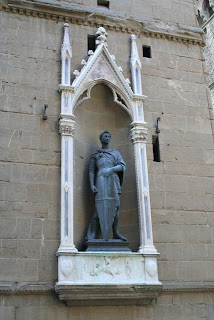
Saint George was also represented above the city gate of San Giorgio, the beautiful relief representing him has been replaced by a copy, and the original is now in the Palazzo Vecchio Museum.
Saint George became the patron saint of England in the thirteenth century. He died ca. 300 as a martyr, decapitated, as he had refused to worship pagan gods as the emperor ordered.

He is celebrated on 23 April, and he is regarded as one of the most prominent military saints. No special event on this day in Florence but just his memory and images in Florence and around...Many foreigners passing through Tuscany since the Middle Ages had probably made St. George so familiar to us.
B
He's not one of the typical, traditional saints of Florence, but the legend of Saint George slaying a dragon dates from the twelfth century and at the beginning of the fifteenth century he was the patron saint of the "Arte degli Armaioli" . Donatello represented him as a young man, standing so proud in one of the niches around the Orsanmichele Church (see the originat at the Bargello museum).

Saint George was also represented above the city gate of San Giorgio, the beautiful relief representing him has been replaced by a copy, and the original is now in the Palazzo Vecchio Museum.
Saint George became the patron saint of England in the thirteenth century. He died ca. 300 as a martyr, decapitated, as he had refused to worship pagan gods as the emperor ordered.

He is celebrated on 23 April, and he is regarded as one of the most prominent military saints. No special event on this day in Florence but just his memory and images in Florence and around...Many foreigners passing through Tuscany since the Middle Ages had probably made St. George so familiar to us.
B
Subscribe to:
Posts (Atom)