Showing posts with label Florence. Show all posts

Friday, August 14, 2020

Pistoia and surroundings...

never crowded, but very interesting art city, with its Ospedale del Ceppo, an hospital founded in 1277, reference pont during the plague oin 1348, famous for its wonderful glazed terracotta reliefs on the façade...


...or even the wonderful, touching statues of the Visitation, representing Mary and Elizabeth, freestandig human size statues completely made of glazed terracotta by famous Renaissance sculptor Luca della Robbia...


...or the armonious Piazza Duomo

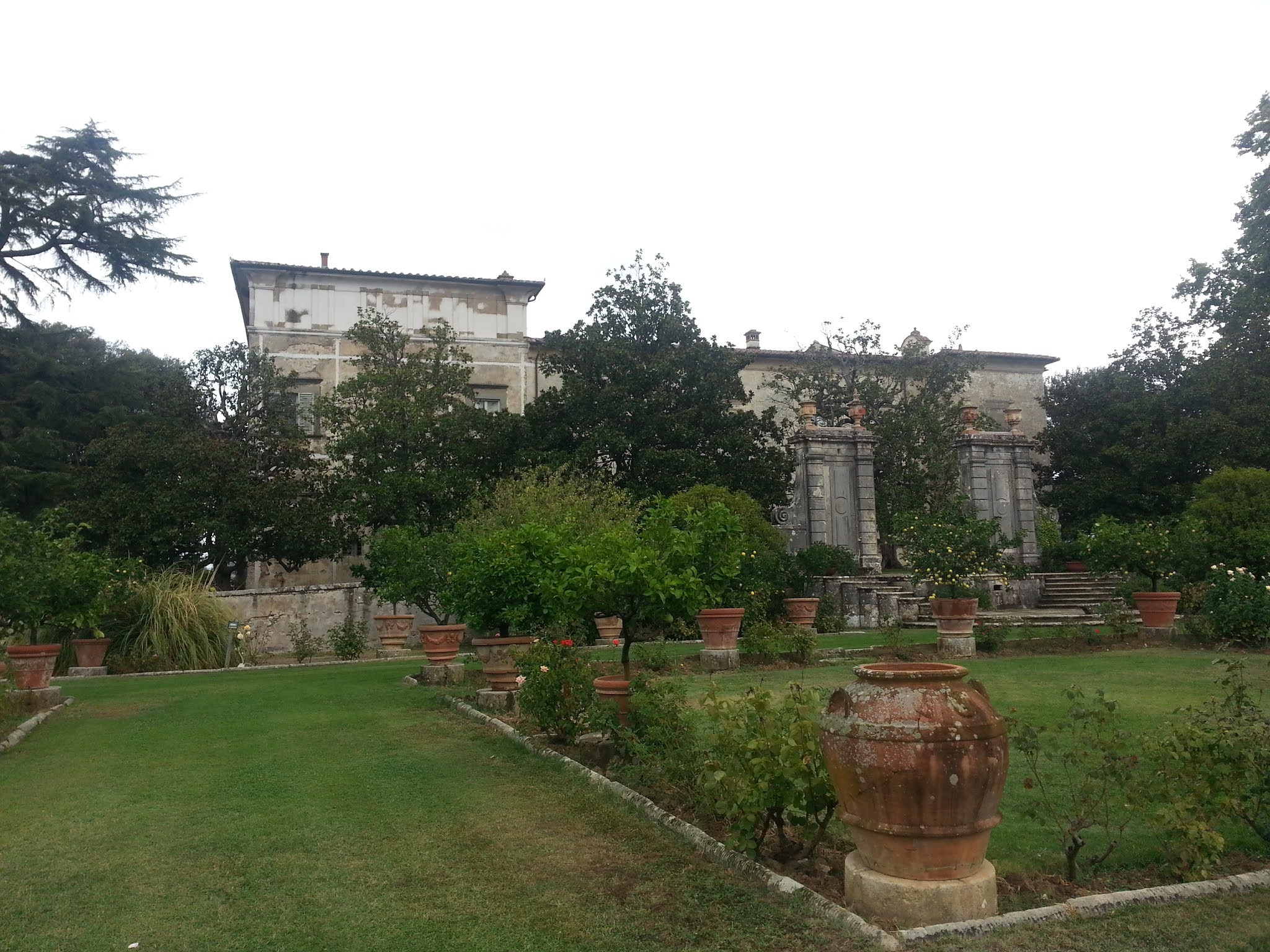
But in the surroundings of Pistoia there is an unexpected Villa, another property of the medici, in very bad confitions actually, but the garden is  fascinating and so is the Limonaia:


these are some of the hidden treasures. Pistoia deserves a visit, and it is easily reachable from Florence. We would be glad to share this with you!

Thursday, July 23, 2020

Villa Gamberaia, near Florence

If you are looking for an incredible and unique garden, never crowded, with wonderful views and interesting design, the garden of Villa Gamberaia is the best place to see.
we offer guided tours to this wonderful garden, for small private groups only. Feel free to contact us for any request!

Tuesday, July 14, 2020

Lungwort (Pulmonaria plant)

This beautiful hairy plant is part of the underwood of Pratolino Park.

It is just one of the many "weeds", a perennial wild plant...This plant is native to western Asia and Europe.
There are about 20 species of Pulmonaria but  "Pulmo", the name, means "Lung" in latin.
This plant is  actually of therapeutic importance for lungs: according to the ancient Doctrine of Signature, herbs and their parts resembling human organs can help to treat diseases of that organ: the grey spots on the leaves look like infected lungs. Therefore the Lungwort came into light for treatments against lung troubles.

Also, this plant is very sensitive to toxins in the area, so you can find it only in unpolluted area! And that is surprisingly not far from Florence.


Astrology in Florence
I am really amazed about how many references to astrology  there are  here! The above image is from San Marco Museum, a Dominican Monastery.
Astrology was once considered, with astronomy, one of the basic teachings of the Quadrivium, together with music, geometry and arithmetic. And the Quadrivium, together with the Trivium (Grammar, Rhetoric and dialectic) were  the "Liberal Arts", the traditional academic program in Western higher education, so much celebrated in our city, even at the base of the wonderful Giotto's Belltower!
The Liberal Arts are related to planets and zodiac signs, as you can see in the 14th Century fresco in the Santa Maria Novella complex.


This is part of a very ancient knowledge that we can investigate. In many works of art  we can discover traces of this...

A walk through  Florence with us can help you discover these (often) forgotten images ;)

Tuesday, July 7, 2020

Parks around Florence


Pratolino Park, in the north area of Florence is a great trip in summer!
This is a public park open during the week end during the summer season. It was once the private park and garden of a wonderful villa, built for Francesco Ist de' Medici at the end of the XVI century.
The highlight of the park is the Appennino Statue and lake, a huge bearded man looking into the lake, full of Lotus flowers. But the park is much more than this.... This wonderful place  deserves a half day tour, and maybe more. I wish you will be able to see it one day!

Friday, July 3, 2020

Not only Florence

When US people say "Tuscany" they often mean the rolling hills covered with vineyards and olive trees in the core of the region. But Tuscany is so much more! Wherever you go it's just beautiful. In this odd summer, so poor of foreign tourists for the horrible pandemic that has suddenly stopped international journeys, I'm spending my holidays on a small island in front of the Tuscan coast. Elba is the biggest island of a group of tiny ones off the Tuscan coast. An hour's journey and you're in heaven! Cristal clear water, fascinating rocks, hidden bays and lots of accommodation. A smart idea to discover an unspoiled corner of Tuscany next time you come, as soon as this odious virus  will be only a bad memory


Tuesday, June 30, 2020

Hello!
we are back!
After the lockdown we are beginning a normal life again. Tuscany seems to be safe enough to tour again, not only through the beautiful and interesting outdoors sites - historical gardens, like the Boboli or Bardini

Gardens - , but also  through our -now quiet- museums. They  are all waiting for us!

So we are ready to take you through these treasures soon... stay tuned!


Wednesday, April 24, 2013

Synergistic gardens

Synergistic agriculture in Italy is having a great success. It was developed by Emilia Hazelip, Spanish permaculturist, in France. She tried to adapt Fukuoka's natural farming to the Mediterranean dry climate.


I had the honour and luck to know her, as I was involved in the project of Solaria Centre of alternative/renewable energies and permaculture in Italy. This project unfortunately failed, but she held a workshop there and we laid down a synergistic garden. This vegetable garden provided good food for the small community. And good fruits for later and other new synergistic gardens.
She died in 2003, but still today many people follow her conceipts. The concept of mulch garden is well known in Permaculture, mulching is a very common technique to cover the soil, retain humidity, fertilize the soil. The soil shouldn't be pressed or compacted, not even digged. weeds are removed by hand...
It is possible to visit some synergistic gardens that have been created in the last years in the surroundings of Florence.


Tuesday, March 27, 2012

The culture week!


From April 14th to 22nd in Italy all state museums will be free for everybody. In Florence you might have heard of Uffizi Museum or Gallery of the Academy , but this is a good occasion to get and see the other wonderful museums, such as the Bargello, with the collection of Donatello masterpieces and the original panels casted by Brunelleschi and Ghiberti for the Baptistry...and the Baccus by Michelangelo...
... or the breathtaking rooms of Palazzo Pitti, with the paintings by Titian, Raphael, Caravaggio...just to mention the most famous ones. If the weather is fine don't forget the Gardens: Boboli and Bardini Gardens are open and during these spring days you can get there as well. You can contact us for museum or garden tours. See you in Florence!

Saturday, May 28, 2011

Florentine mosaics

Only skilled and experienced craftmen are able to transform the rough stone in a "painting". The inlay work is a very difficult technique that need precision, creativity, deep knowledge of the different stones and their nuance, structure, and, above all,  passion.
This is the result of three years' work by Jacopo Lastrucci, from the Lastrucci workshop in Florence: the Sibilla Libica, from the fresco by Michelangelo in the Sistine Chapel. This wonderful panel can be seen in the workshop. It is a nice experience to visit the workshop and see the Lastruccis working and creating new mosaics.
The inlay work, or "commesso in pietre dure", as we call it in Italian, was started in 1588, when Ferdinando I De' Medici founded the Opificio delle Pietre Dure for the decoration of the interior of the Princes' Chapel in San Lorenzo.
The stones were marbles, granites, porphyre, jaspis, lapis lazuli, calcedonium, malachite, quartz.....
The museum of the Opificio delle Pietre Dure displays the stones used, the working tools used to cut them, to glue the pieces, and the evolution of this technique from the end of the 16th century to the modern times.
Also, in occasion of the 150th anniversary of Italy, an interesting exhibition is now going on in the Gallery of Modern Art until next September: when Tuscany became part of the Italian Kingdom the granducal manifacture  (Opificio delle Pietre Dure) started to have a larger public...

Sunday, April 24, 2011

A cow for the Duomo

When Brunelleschi's Cupola was built, timber frameworks surrounded the cathedral. The north side of the Duomo faces via de' Servi, and in one of these apartmente a young and nice taylor lived and worked, who sometimes came to the window to get more light, or simply to look at the men working at the cupola, when her husband wasat w ork. A love story started, and one of these stone carvers sculpted a head of a cow, with a big pair of horns, facing the balcony of the young girl maybe to warn her husband.


Well, this is what people said....But the reason of the head of a cow sculpted on top of the frames at the base of the cupola is probably another one: maybe it is just to say thanks to these animals that made possible such a great work!

Saturday, April 16, 2011

St. George

Soon it will be St. George's Day!
He's not one of the typical, traditional saints of Florence, but the legend of Saint George slaying a dragon dates from the twelfth century and at the beginning of the fifteenth century he was the patron saint of the "Arte degli Armaioli" . Donatello represented him as a young man, standing so proud in one of the niches around the Orsanmichele Church (see the originat at the Bargello museum).

Saint George was also represented above the city gate  of San Giorgio, the beautiful relief representing him  has been replaced by a copy, and the original is now in the Palazzo Vecchio Museum.

Saint George became the patron saint of England in the thirteenth century. He died ca. 300 as a martyr, decapitated, as he had refused to worship pagan gods as the emperor ordered.

He is celebrated on 23 April, and he is regarded as one of the most prominent military saints. No special event on this day in Florence but just his  memory and images in Florence and around...Many foreigners passing through Tuscany since the Middle Ages had probably made St. George so familiar to us.


B

Wednesday, March 30, 2011

San Miniato al Monte


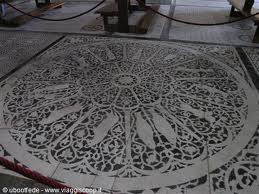
While visiting the beautiful romanesque church of San Miniato al Monte you will be fascinated by its location, and while looking at the marvellous ancient pavement, displaying the most remarkable zodiac in Italy, if not in the world, you will read:


"hic valvis ante. celesti numine dante;.mccvii.re
metricus et iudex. hoc fecit condere joseph;.tinent de
ergo rogo cristum.quod semper vivat in ipsum;.tepore mte"

This is written on the marble pavement of San Miniato Church, dating back to 1207. Now observe only the two last words of each line:
"1207. Retinent de tempore et morte" - " these things preserve from time and death".
Which kind of things?

San Miniato is not only a wonderful religious building but it is rich of symbolism. The zodiac is in relationship with the church and its exterior marble façade, like a philosophical machine.


Even the church has been designed and orientated to express the deep relationship between the universe, Christ and the human beeing.
You might say that the zodiac and all astrological ideas are thoroughly pagan, therefore you will be surprised to find a zodiac in a Christian church. Well, this is not the only one in Florence: even in the Baptistry you can see one.
This is probably the expression of the effort to christianize the pagan astrology, but not only....

Friday, March 25, 2011

Firenze Card on March 25th!

Today is the first day of a new Florentine year! The Capodanno Fiorentino has been celebrated for centuries on March 25th...It corresponds to the equinoxe, the beginning of spring, and to the Annunciation.
Even though the year begins officially on January 1st since 1750 now, Florentines cannot imagine this special day without any special event!
Today there were guided tours and pageants in the city up to the church of SS. Annunziata. But we are also glad to inform everybody that the Firenze Card is now available in the city and in the tourist information office of Via Cavour n. 1r (close to the Medici Palace). It is promoted by the Municipality of Florence, the Ministry for the Arts and Cultural Activities, the Regional Direction of Cultural Heritage, the Special Superintendence for Historical, Artistic and Ethnic-anthropological Heritage and for the Museum Circuit of the city of Florence, the Province of Florence and the Chamber of Commerce of Florence, in collaboration with ATAF.

With the Firenze card you won't have to queue anymore and for 72 hours you will be admitted to over 30 museums and city buses. The Firenze card costs 50€ per person. See details: www.firenzecard.it ....and have a nice stay!

Tuesday, March 8, 2011

Primavera has arrived!

Today was a wonderful day in Florence. Museums were open for free for all women and people enjoyed the spring air and the sun rays in piazza della Repubblica.

well, it's not Primavera yet but the air is warming up and the flowers in the gardens are ready to bloom. Here  is a shot from my garden: crocus sativus, used since centuries for the precious saffron, the princes and knights food...because its stigmas made food look like gold.


You can easily find them in the forest or historical gardens ...but hurry up, or you will have to wait for the next primavera...

Sunday, March 6, 2011

Camelias near Florence

DID YOU KNOW...?

There is a place, close to Florence, where Camellia's plants grow as shrubs and trees in February and March as you were in East Asian. Come and visit two rural villages in the beautiful Tuscan countryside, Sant'Andrea and Pieve di Compito (in the municipality of Capannori), where among typical stone houses, pinewoods, olive groves  and a gurgling stream you can follow the Camellia's Path during the wonderful Ancient Camellia's of Lucchesia Show that takes place in March 2011. Introduced during the XIX century, several different species of this evergreen plant have been successfully cultivated thanks to the warm-humid climate of these hills . So a great variety of Camellias  (single petal, semi-double, double flower, anemone form and peony form flower) with their showy white, red, pink, jellow, or variegated blossoms such as the  Camellia  japonica (common camellia) or the C. crysanta, C. sasanqua, the C. oleifera  and the newly cultivated  C. sinensis for tea show themselves  to botanists, art historians and flower enthusiasts.

Ask us for further information.

Monday, February 28, 2011

FLORENTINE NEW YEAR

New Year's in March? That's right. Until 1582, Europe rang in the New Year on March 25, the Feast Day of the Annunciation. In 2000, the Capodanno Fiorentino was reinserted into the calendar of traditional Florentine events. The city now celebrates the Florentine New Year on the Sunday following March 25, which this year is March 28, with a historic procession from the Palagio di Parte Guelfa to the Basilica of Santissima Annunziata. The day continues with a mass, live music, exhibits and a lively market in the piazza. Call 055/2768037 or click http://www.comune.fi.it/.

Sunday, February 6, 2011

It's born !!

On a cold and sunny winter day, while sipping a cup of tea and talking about the lovely city where we live, we girls...thought we might share our passion for Florence with you: here is our blog!