Tuesday, April 19, 2011

Volonteering in Boboli Garden


When I am not busy with guiding, my favourite target is Boboli Garden at the back of Pitti Palace. It's the prototype of the Italian garden.Vast and tidy, geometrically arranged, it's the realm of immagination. Everything looks natural though it was shaped by the skillful hands of marvellous architects in the 16th century. A maze of lanes sided with baybush suddenly open up to show large ponds populated by gods of marble. Pritty woods lead to the orangerie that boasts one of the largest collection of citrus plants. There I help the stuff with the hard work that a vast garden like this requires: pruning the roses and tying the grape branches in the vineyard, weeding the flowerbeds and cleaning the orangerie. I learn how to take care of plants and its great fun! Better than going to the analyst: you go back home relaxed and full of flowers.

Saturday, April 16, 2011

St. George

Soon it will be St. George's Day!
He's not one of the typical, traditional saints of Florence, but the legend of Saint George slaying a dragon dates from the twelfth century and at the beginning of the fifteenth century he was the patron saint of the "Arte degli Armaioli" . Donatello represented him as a young man, standing so proud in one of the niches around the Orsanmichele Church (see the originat at the Bargello museum).

Saint George was also represented above the city gate  of San Giorgio, the beautiful relief representing him  has been replaced by a copy, and the original is now in the Palazzo Vecchio Museum.

Saint George became the patron saint of England in the thirteenth century. He died ca. 300 as a martyr, decapitated, as he had refused to worship pagan gods as the emperor ordered.

He is celebrated on 23 April, and he is regarded as one of the most prominent military saints. No special event on this day in Florence but just his  memory and images in Florence and around...Many foreigners passing through Tuscany since the Middle Ages had probably made St. George so familiar to us.


B

Wednesday, March 30, 2011

San Miniato al Monte


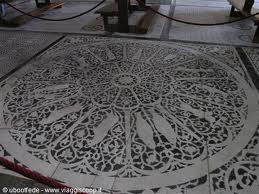
While visiting the beautiful romanesque church of San Miniato al Monte you will be fascinated by its location, and while looking at the marvellous ancient pavement, displaying the most remarkable zodiac in Italy, if not in the world, you will read:


"hic valvis ante. celesti numine dante;.mccvii.re
metricus et iudex. hoc fecit condere joseph;.tinent de
ergo rogo cristum.quod semper vivat in ipsum;.tepore mte"

This is written on the marble pavement of San Miniato Church, dating back to 1207. Now observe only the two last words of each line:
"1207. Retinent de tempore et morte" - " these things preserve from time and death".
Which kind of things?

San Miniato is not only a wonderful religious building but it is rich of symbolism. The zodiac is in relationship with the church and its exterior marble façade, like a philosophical machine.


Even the church has been designed and orientated to express the deep relationship between the universe, Christ and the human beeing.
You might say that the zodiac and all astrological ideas are thoroughly pagan, therefore you will be surprised to find a zodiac in a Christian church. Well, this is not the only one in Florence: even in the Baptistry you can see one.
This is probably the expression of the effort to christianize the pagan astrology, but not only....

Friday, March 25, 2011

Firenze Card on March 25th!

Today is the first day of a new Florentine year! The Capodanno Fiorentino has been celebrated for centuries on March 25th...It corresponds to the equinoxe, the beginning of spring, and to the Annunciation.
Even though the year begins officially on January 1st since 1750 now, Florentines cannot imagine this special day without any special event!
Today there were guided tours and pageants in the city up to the church of SS. Annunziata. But we are also glad to inform everybody that the Firenze Card is now available in the city and in the tourist information office of Via Cavour n. 1r (close to the Medici Palace). It is promoted by the Municipality of Florence, the Ministry for the Arts and Cultural Activities, the Regional Direction of Cultural Heritage, the Special Superintendence for Historical, Artistic and Ethnic-anthropological Heritage and for the Museum Circuit of the city of Florence, the Province of Florence and the Chamber of Commerce of Florence, in collaboration with ATAF.

With the Firenze card you won't have to queue anymore and for 72 hours you will be admitted to over 30 museums and city buses. The Firenze card costs 50€ per person. See details: www.firenzecard.it ....and have a nice stay!

Tuesday, March 8, 2011

Primavera has arrived!

Today was a wonderful day in Florence. Museums were open for free for all women and people enjoyed the spring air and the sun rays in piazza della Repubblica.

well, it's not Primavera yet but the air is warming up and the flowers in the gardens are ready to bloom. Here  is a shot from my garden: crocus sativus, used since centuries for the precious saffron, the princes and knights food...because its stigmas made food look like gold.


You can easily find them in the forest or historical gardens ...but hurry up, or you will have to wait for the next primavera...

Sunday, March 6, 2011

Camelias near Florence

DID YOU KNOW...?

There is a place, close to Florence, where Camellia's plants grow as shrubs and trees in February and March as you were in East Asian. Come and visit two rural villages in the beautiful Tuscan countryside, Sant'Andrea and Pieve di Compito (in the municipality of Capannori), where among typical stone houses, pinewoods, olive groves  and a gurgling stream you can follow the Camellia's Path during the wonderful Ancient Camellia's of Lucchesia Show that takes place in March 2011. Introduced during the XIX century, several different species of this evergreen plant have been successfully cultivated thanks to the warm-humid climate of these hills . So a great variety of Camellias  (single petal, semi-double, double flower, anemone form and peony form flower) with their showy white, red, pink, jellow, or variegated blossoms such as the  Camellia  japonica (common camellia) or the C. crysanta, C. sasanqua, the C. oleifera  and the newly cultivated  C. sinensis for tea show themselves  to botanists, art historians and flower enthusiasts.

Ask us for further information.

Wednesday, March 2, 2011

Vinum Nostrum

Wine is a typical product of the Mediterranean countries, since its production was started many centuries ago in Georgia and then spread out all over in Minor Asia, North Africa and, through the Greeks,  Etruria, or Enotria (Enos= wine).
This very interesting exhibition takes place now at the Silverware Museum in Pitti Palace until May 15th and deals with the development of wine, grape species and selection, landscapes, clay tools related to wine, commerce networks, and of course the myth of Dionisus.
I visited the exhibition last week and I think that this is a "must" for all those who love wine culture. This could also be the starting point for wine tasting, tours of farms and beautiful ancient cellars around Florence.